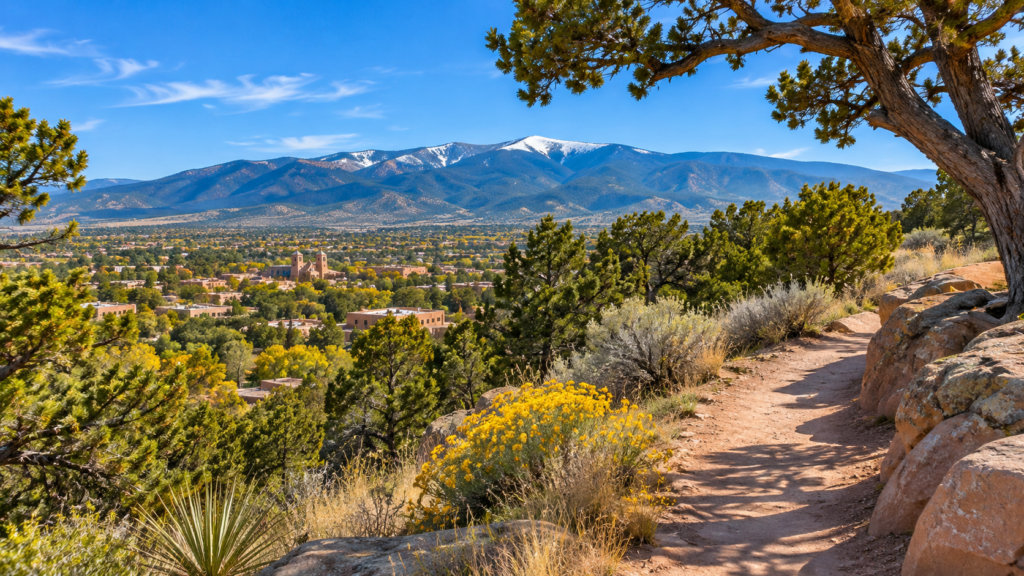
Santa Fe is higher than Denver, and visitors arriving from lower elevations may notice the difference. Here’s what to expect when you come to see homes—and how to make your visit more comfortable.
Santa Fe sits at approximately 7,000 feet above sea level, according to the National Park Service. That makes it the highest state capital in the nation and roughly 1,700 feet higher than Denver, the “Mile High City.”
Elevation varies across Santa Fe and its surrounding communities, so the altitude at a particular property may be different from the city’s commonly cited elevation.
If you’re flying in from the coast or another low-elevation area to look at homes, a little preparation can make your visit far more enjoyable.
What to Expect in Your First Few Days
At Santa Fe’s elevation, the air still contains approximately 21% oxygen, just as it does at sea level. However, lower atmospheric pressure means fewer oxygen molecules are available with each breath.
Your body may need time to adjust.
You might notice shortness of breath when climbing stairs, unexpected fatigue, or changes in your sleep. Not everyone experiences noticeable symptoms, and the effects vary from person to person.
According to the CDC’s guidance on high-altitude travel, much of the body’s initial acclimatization happens over the first three to five days, with further adjustments continuing over subsequent weeks.
If you can, leave a little breathing room in your itinerary.
Keep your first day of home tours manageable, take breaks when needed, and consider saving more strenuous mountain hikes for later in your visit.
That way, you can focus on exploring the homes and neighborhoods you’re here to see.
Altitude Sickness: Symptoms and What to Do
Acute mountain sickness, or AMS, is the most common form of altitude illness.
The risk is generally greater at elevations of 8,000 feet or higher, although some people can experience symptoms at lower elevations.
Symptoms often resemble a hangover and may include:
- Headache
- Unusual fatigue
- Dizziness
- Nausea or loss of appetite
- Occasionally, vomiting
According to the CDC, symptoms typically begin within two to twelve hours of arriving at a higher elevation. Mild cases often improve within 12 to 48 hours if the person doesn’t ascend farther.
If you experience possible symptoms, avoid going to a higher elevation and take time to rest. Seek medical advice if symptoms persist, worsen, or are difficult to distinguish from another illness.
Know the emergency warning signs.
Two uncommon but serious forms of altitude illness require immediate medical attention:
- High-altitude cerebral edema (HACE): A dangerous condition affecting the brain that can cause confusion, unusual drowsiness, or trouble walking normally.
- High-altitude pulmonary edema (HAPE): A dangerous condition affecting the lungs that may cause worsening breathlessness, including at rest, along with coughing, chest congestion, or marked weakness.
These symptoms are medical emergencies. Call for emergency medical help immediately. Moving to a lower elevation and receiving oxygen may be necessary, but don’t delay medical care or attempt an unsafe descent.
If you have an existing medical condition, talk with your doctor before traveling.
The CDC recommends additional medical guidance for travelers with certain heart or lung conditions, sleep apnea, or other health concerns. Those who are pregnant or managing conditions such as diabetes should also discuss their travel plans with a qualified healthcare professional.
How Altitude and Alcohol Mix
Santa Fe’s food and drink scene is one of the best parts of visiting, so I always give my clients a friendly reminder about the margaritas.
There’s a popular belief that alcohol automatically affects your blood alcohol level more dramatically at high altitude. The research is more complicated than that, and altitude alone doesn’t mean one margarita suddenly doubles your blood alcohol concentration.
Still, there are good reasons to take it easy when you first arrive.
The symptoms can overlap. Alcohol and altitude can both contribute to headache, dizziness, nausea, and fatigue. A hangover may be confused with altitude illness, making it harder to recognize what your body is experiencing.
Alcohol can interfere with sleep and breathing. Your body adjusts to higher elevations partly by increasing breathing. Alcohol can interfere with that process, and sleep may already be less restful during the initial adjustment period.
Hydration still matters. Alcohol can contribute to fluid loss, while Santa Fe’s dry climate and the changes in your breathing at elevation can increase your need to pay attention to hydration.
Serious symptoms shouldn’t be dismissed. Confusion, poor coordination, or unusual difficulty breathing should not automatically be blamed on drinking. Seek urgent medical help when severe symptoms appear.
The CDC advises avoiding alcohol for the first 48 hours at high altitude. Its public traveler guidance specifically recommends this precaution for people arriving above 8,000 feet.
Santa Fe’s typical city elevation is below that threshold, but taking it easy with alcohol during your first couple of days is still a sensible choice—especially if you’re also planning to visit higher mountain areas.
My suggestion? Enjoy Santa Fe’s food scene first, give yourself time to settle in, and consider saving that celebratory margarita for later in your trip.
Stay Hydrated, but Don’t Overdo It
Santa Fe’s dry climate and the changes in breathing that occur at elevation can increase fluid loss.
Dehydration can also cause headaches and fatigue, making it harder to recognize possible altitude-related symptoms.
Drink water regularly throughout the day and pay attention to how you’re feeling, especially if you’re walking between showings or exploring outdoors.
But there’s no need to force excessive amounts of water.
The Wilderness Medical Society’s clinical guidelines explain that overhydration has not been shown to prevent altitude illness and can create health risks of its own.
The goal is to stay adequately hydrated—not to drink as much water as possible.
Elevation Varies More Than You Might Expect
“Santa Fe altitude” isn’t just one number.
The city is commonly described as sitting at approximately 7,000 feet, but elevations vary throughout the surrounding region.
Lower-lying communities to the south may be closer to 6,000 feet, while the terrain rises substantially toward the Sangre de Cristo Mountains.
Consider a few nearby examples:
- Central Santa Fe: Approximately 7,000 feet above sea level.
- Hyde Memorial State Park: Approximately 8,300 to 9,400 feet.
- Ski Santa Fe: A base elevation of 10,350 feet, about 16 miles from downtown Santa Fe.
That’s a difference of more than 3,000 feet between the city’s commonly cited elevation and the ski area’s base.
Why does this matter?
The elevation where you sleep is especially important in assessing altitude-illness risk.
If you’re exploring homes in Santa Fe’s higher foothills, staying or spending time there may feel different from visiting properties closer to the Plaza.
And if you’re planning a day trip up the mountain, it may help to spend some time adjusting in town first.
For buyers relocating from lower elevations, a property’s specific location and elevation can be worth considering alongside its other features.
Every Home Has Its Own Story
Elevation is just one of the things that makes Santa Fe properties different from one another.
Views, sun exposure, architectural character, land, and access to outdoor recreation all vary depending on where a home is located.
Some buyers love the convenience of neighborhoods closer to downtown. Others are drawn to the higher foothills, mountain scenery, and trail access.
For my sellers, I believe in building each listing’s marketing around what makes that particular property unique.
For my buyers, I help compare those differences so they can make informed decisions about the home and lifestyle they want.
Santa Fe itself has quite a story.
Founded in 1610, it is the nation’s oldest state capital as well as its highest. The National Park Service also recognizes Santa Fe as a historic hub of three National Historic Trails: the Santa Fe Trail, the Old Spanish Trail, and El Camino Real de Tierra Adentro.
That combination of history, landscape, and elevation is part of what makes the City Different so memorable.
Frequently Asked Questions About Santa Fe’s Altitude
Is Santa Fe really higher than Denver?
Yes. Santa Fe is approximately 7,000 feet above sea level, compared with Denver’s approximately 5,280 feet—a difference of about 1,700 feet.
Can you get altitude sickness in Santa Fe?
Yes, although not everyone will experience it. The risk generally increases at elevations above 8,000 feet, but symptoms can occur lower. Headache accompanied by fatigue, dizziness, or nausea after ascending may be a sign of altitude illness.
Do you get drunk faster at high altitude?
Altitude doesn’t automatically mean your blood alcohol concentration rises faster. However, alcohol can interfere with sleep and breathing, and its effects may overlap with altitude-related symptoms. Taking it easy during your first couple of days is a reasonable precaution.
How long does it take to adjust to Santa Fe’s altitude?
The initial acclimatization process generally takes about three to five days. Mild altitude-related symptoms may improve sooner, while further physiological adjustments can continue for weeks. Individual experiences vary.
Does elevation change depending on where I buy?
Yes. Properties throughout Santa Fe and the surrounding county can sit at different elevations, especially as the terrain rises toward the mountains. Ask about the elevation of a specific home if that’s important to your relocation plans.
Thinking About a Move to Santa Fe?
Living at approximately 7,000 feet can take some getting used to, especially when you’re arriving from a much lower elevation.
A comfortable itinerary, reasonable activity levels, normal hydration, and attention to how you’re feeling can help make your visit more enjoyable.
And if you’re touring homes while you’re here, I can help you explore the neighborhoods, property features, and lifestyle considerations that make Santa Fe such a distinctive place to live.
As an Associate Broker with Sotheby’s International Realty and a Certified Santa Fe Specialist (SFeS), I bring seven years of real estate experience, 85 closed transactions, and 47 five-star client reviews.
I was born and raised in Santa Fe, and I’d love to help you find a home that fits your life—or showcase what makes the home you’re selling special.
Lori Montoya
Associate Broker | Sotheby’s International Realty
Certified Santa Fe Specialist (SFeS)
Call/Text: 505-577-8750
Website: https://santafewithlori.com/
Honest. Local. Personal. The way real estate should be!
Sources and Helpful Resources
- CDC Yellow Book — High-Altitude Travel and Altitude Illness
- CDC — Travel to High Altitudes
- Wilderness Medical Society — 2024 Altitude Illness Guidelines
- National Park Service — Santa Fe, New Mexico
- New Mexico State Parks — Hyde Memorial State Park
- Ski Santa Fe — Mountain Information
Medical disclaimer: This article is intended for general relocation and travel information only. It is not medical advice or a substitute for evaluation by a qualified healthcare professional. Anyone with health concerns about traveling to higher elevations should consult their physician. Seek immediate medical attention for severe or worsening symptoms.