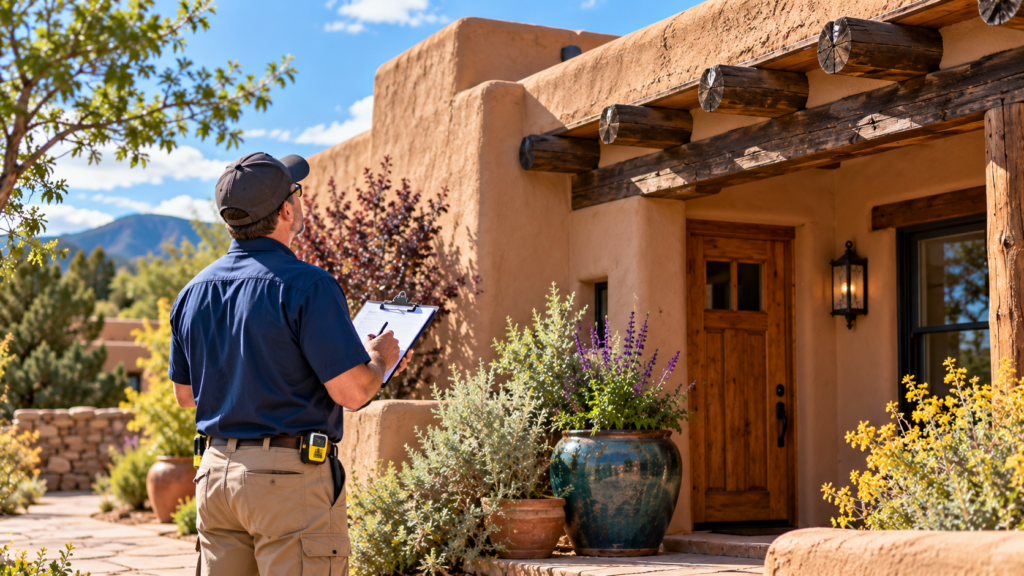
What are the benefits of getting your home inspected before going on the market in Santa Fe?
A pre-listing inspection gives you information before buyers conduct their own inspections. You can identify potential issues, plan repairs on your schedule, and help prospective buyers evaluate your home’s condition with greater confidence.
It doesn’t guarantee a trouble-free sale, but it can put you in a better position to prepare, price, and negotiate thoughtfully.
Why This Matters for Santa Fe Sellers Right Now
If you are thinking about selling a home in Santa Fe, NM, I want you to consider something many sellers overlook: getting your home inspected before it ever hits the market.
Not after you accept an offer. Not when a buyer’s inspector walks through and hands you a surprise list of problems. Before.
Santa Fe’s housing stock is unique. Adobe walls, vigas, flat roofs, evaporative coolers, kiva fireplaces. These are features that make many of our homes beautiful, and they are also features that deserve careful attention when evaluating a property’s condition.
As someone born and raised here with years of experience helping sellers navigate this market, I believe a pre-listing inspection can be one of the most strategic preparation steps to consider.
It doesn’t eliminate every risk, but it can help you make informed decisions before the transaction is underway.
Whether your home sits near the Plaza, up in the foothills off Hyde Park Road, or out toward Eldorado, the principle is the same. Knowledge is power, and a pre-listing inspection can give you more of it.
Getting Ahead of Unknown Issues in Your Santa Fe Home
Here is what I tell my sellers: you have lived in your home. You know its personality. But you may not know everything about the condition of its systems and structural components.
That is not a knock on you as a homeowner. It is simply reality.
According to the National Association of REALTORS® Consumer Guide to Home Inspections, a home inspector generally evaluates accessible components such as the structure, exterior, roof, plumbing, electrical systems, heating and cooling, interiors, ventilation, insulation, and fireplaces.
Additional testing for concerns such as mold, radon, lead paint, or asbestos may be appropriate in certain circumstances, but these services are not necessarily included in a standard inspection.
In Santa Fe, where many homes feature older construction, flat or low-slope roofs that can develop drainage issues, and wood-burning fireplaces that may need servicing, these categories deserve attention.
An evaporative cooler that worked fine last summer might have a deteriorating pan. A viga that looks beautiful from the living room might have visible signs of moisture damage that warrant further evaluation.
A standard home inspection is generally visual, noninvasive, and nondestructive. It cannot identify every hidden condition or replace specialized evaluations when concerns arise.
Still, identifying potential problems early gives you time to evaluate, plan, and respond.
You are not discovering everything for the first time during negotiations. You have had an opportunity to become better informed.
What Surprises Come Up Most Often?
NAR notes that seemingly minor issues, like a drip under a bathroom sink, a loose faucet, or a rocking toilet, can raise concerns for cautious buyers.
In my experience, the small stuff deserves attention along with the big stuff.
A buyer who notices several minor plumbing problems may begin wondering what else needs maintenance, even if there are no major structural concerns.
By addressing those items early, you may remove some of that uncertainty before it becomes a sticking point in the transaction.
Making Repairs on Your Terms, Not the Buyer’s
This is the part that often resonates with my sellers.
When a buyer’s inspection reveals problems after a home is under contract, the seller may have to evaluate repair requests, obtain contractor estimates, and make decisions while working within contractual deadlines.
A pre-listing inspection gives you an opportunity to do some of that work earlier.
You can review the findings, decide which repairs deserve priority, and seek estimates before listing.
According to NAR’s guide to preparing to sell your home, a seller is not generally required to conduct a pre-sale inspection, but choosing one may help identify conditions worth addressing before showings begin.
What does that look like in practice?
- Choose your priorities. A cracked roof parapet may warrant prompt evaluation and repair, while a superficial stucco crack may need a different response.
- Shop for competitive bids. You may have time to compare qualified contractors rather than making a rushed decision during negotiations.
- Handle repairs before showings. Buyers can evaluate the property’s current condition, and you can provide relevant documentation of completed work.
- Address known conditions transparently. If you choose not to repair an issue, you can discuss how it affects your pricing strategy while meeting applicable disclosure requirements.
That last point is especially important.
In New Mexico, known adverse material facts must be handled in accordance with applicable disclosure requirements and the purchase agreement. Real estate brokers also have duties concerning adverse material facts actually known to them.
A seller’s ability to choose which repairs to undertake is not the same as having discretion to conceal a known material defect.
The goal is to make thoughtful decisions and communicate transparently, not to hide issues from prospective buyers.
Giving Santa Fe Buyers the Confidence to Submit Strong Offers
Think about this from the buyer’s perspective.
Someone purchasing a home in Santa Fe may be unfamiliar with adobe construction, flat roofs, or the nuances of maintaining a property in our high-desert climate.
Even local buyers can encounter features and systems they haven’t owned before.
Uncertainty about a home’s condition can add hesitation.
When you provide an appropriate pre-listing inspection report, along with available documentation of repairs or additional evaluations, you give prospective buyers information they can consider as part of their decision.
As discussed in NAR’s reporting on pre-listing inspections, being proactive about the home’s condition may help establish trust.
But a seller-provided report is not a guarantee that buyers will offer more, request fewer repairs, or waive contractual protections.
How Does This Affect Contingencies?
Some buyers may feel more comfortable evaluating a home when they can review inspection findings and repair records before making an offer.
However, buyers may still want an independent inspection, and I encourage them to evaluate the property according to their own needs and contractual rights.
A pre-listing report can provide useful background information, but it should not replace the buyer’s own due diligence.
The practical advantage for a seller is preparation: you may already understand the issues a buyer is likely to raise and have estimates, repair records, or other information ready for discussion.
That can make negotiations more informed, even when the buyer conducts a separate inspection.
Preventing Deals from Falling Apart in Santa Fe County
Few things are more frustrating than going under contract, mentally moving forward, and then watching a deal fall apart because of unexpected inspection findings.
NAR has reported on real estate professionals who recommend pre-listing inspections as one way to identify potential transaction obstacles earlier.
A pre-listing inspection cannot eliminate every surprise.
A buyer’s inspector may identify an issue that the first inspection missed, or a buyer may have different concerns about the property’s condition.
However, addressing known issues before listing may reduce the likelihood of certain repair disputes arising for the first time after a contract has been signed.
This matters throughout Santa Fe County, where properties can vary substantially in age, construction, utilities, access, and maintenance requirements.
For a home with a private well, septic system, or other specialized features, additional evaluations or documentation may be appropriate.
For example, New Mexico generally requires a property-transfer evaluation for an established on-site liquid-waste system. That is separate from an optional general pre-listing home inspection.
As a Certified Santa Fe Specialist and Pricing Strategy Advisor, I consider property condition and preparation as part of a broader listing strategy.
The goal is to support a more informed process from listing to closing—not to promise that no complications will occur.
What a Pre-Listing Inspection Costs Versus What It Saves in Santa Fe
You might be wondering whether the upfront expense is worth it.
The cost depends on your home’s size, age, accessibility, and the scope of the inspection. Additional specialist evaluations may involve separate fees.
Rather than assuming every inspection pays for itself, I encourage sellers to consider what the information could help them accomplish.
Here are two hypothetical situations.
- Without a pre-listing inspection: A buyer’s inspector identifies roof drainage concerns, aging electrical components, and a leaking evaporative cooler after the home is under contract. The parties must then evaluate those findings, discuss possible repairs or credits, and decide how to proceed within the contract’s deadlines.
- With a pre-listing inspection: The seller learns about those conditions earlier, obtains estimates, addresses selected concerns, and appropriately discloses known material conditions. The buyer may still request an independent inspection and negotiate further, but the seller has had more time to prepare.
Neither scenario guarantees a particular outcome.
As NAR explains in its Consumer Guide to Preparing to Sell Your Home, a pre-sale inspection can identify potential issues for consideration before showing a property and may serve as a differentiator.
For Santa Fe homes near Canyon Road, in the Railyard District, or throughout the Historic Eastside, distinctive architectural features can make that early evaluation particularly useful.
If you’re considering an inspection, obtain a quote from a New Mexico-licensed home inspector and ask exactly what the service includes.
For a broader look at repair expenses and other costs involved in selling, read my guide to the true cost of selling a home in Santa Fe.
Is a pre-listing inspection required?
A general pre-listing home inspection is not typically required simply because you’re putting your house on the market. Certain property systems may have their own evaluation requirements, however.
Is it worth considering?
Absolutely. But whether it’s the right investment depends on the property, its known condition, your timeline, and your selling strategy.
Frequently Asked Questions
Is a pre-listing home inspection required to sell in Santa Fe, NM?
No. A general pre-listing inspection is not normally required just to market and sell a home.
However, some property-specific requirements may apply. For example, an established on-site liquid-waste system is generally subject to a property-transfer evaluation under New Mexico regulations.
It’s important to understand which requirements apply to your particular property.
What Does a Home Inspector Look at During a Pre-Listing Inspection in Santa Fe?
According to NAR, a general inspection typically covers accessible portions of the structure, exterior, roof, plumbing, electrical systems, heating and cooling, interiors, ventilation, insulation, and fireplaces.
In Santa Fe, features such as flat roofs, adobe walls, vigas, fireplaces, and evaporative coolers may deserve special attention.
The inspection is generally noninvasive and may recommend further evaluation by a qualified specialist.
How Does a Pre-Listing Inspection Help Me Control Repairs?
It gives you time to understand the findings, decide which repairs to prioritize, seek contractor estimates, and plan work before going on the market.
You may also decide to account for certain conditions in the asking price, subject to applicable disclosure and contractual requirements.
Will Buyers Still Do Their Own Inspection if I Provide Mine?
Many will, and that’s perfectly reasonable.
Your pre-listing report can offer useful information, but buyers should still have the opportunity to conduct their own due diligence.
Can a Pre-Listing Inspection Help My Santa Fe Home Sell Faster?
It may help identify and address concerns that could otherwise complicate a sale, but there is no guarantee that it will shorten marketing time or produce a faster closing.
Sale timing also depends on pricing, location, condition, buyer demand, financing, and other factors.
Do I Have to Fix Everything the Pre-Listing Inspection Finds?
Not necessarily.
Sellers can often decide which repairs to make, although safety issues, lender requirements, contractual obligations, or other regulations may affect those decisions.
Known adverse material facts must still be addressed under applicable disclosure rules and agreements.
How Much Does a Pre-Listing Inspection Typically Cost?
Costs vary with the size, age, and complexity of the property, as well as any additional evaluations requested.
I recommend obtaining a quote from a New Mexico-licensed home inspector and confirming what is included before scheduling.
Should I Share the Pre-Listing Inspection Report With Buyers?
Sharing an inspection report can support transparency and give buyers useful information about the property’s condition.
However, the appropriate way to provide the report and disclose its findings should be discussed with your listing broker, taking into account the inspection agreement and applicable disclosure requirements.
What Santa Fe-Specific Issues Should I Watch for in a Pre-Listing Inspection?
Flat roof drainage and membrane condition, visible moisture concerns in adobe or wood features, fireplace and chimney safety, and evaporative cooler operation are useful areas to consider.
Depending on the property, well, septic, or other specialized evaluations may also be appropriate.
Not every concern will be included in a general home inspection, so discuss the scope with your inspector.
How Does a Pre-Listing Inspection Affect Negotiations in Santa Fe?
It can help you prepare for discussions about property condition and potential repairs.
Buyers may still request credits, additional inspections, or repairs based on their findings.
The advantage is having more information and preparation time—not controlling or guaranteeing the outcome of negotiations.
The Bottom Line
Selling a home in Santa Fe is about more than listing it and waiting for offers.
It’s about positioning yourself for the strongest possible outcome from day one.
A pre-listing inspection can give you useful information about your home’s condition, more time to evaluate potential repairs, and an opportunity to approach buyer questions with greater preparation and transparency.
It won’t eliminate every challenge, and it isn’t automatically the right choice for every property.
But when it makes sense, it can be a valuable part of a thoughtful selling strategy.
As a Santa Fe native and Associate Broker with Sotheby’s International Realty, I enjoy helping homeowners understand their options and prepare their properties with confidence.
If you’re considering selling your home in Santa Fe or anywhere in Santa Fe County, I’d love to talk through whether a pre-listing inspection makes sense for your situation.
Lori Montoya
Associate Broker | Sotheby’s International Realty
Call or text: (505) 577-8750
SantaFeWithLori.com
Honest. Local. Personal. The way real estate should be!