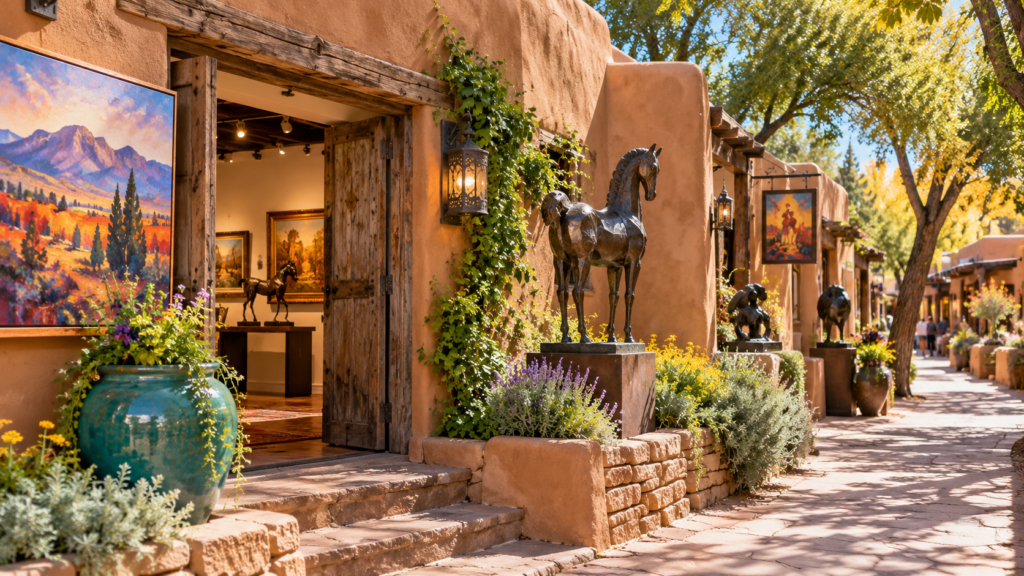
Canyon Road brings more than 100 art galleries into roughly half a mile of historic adobe buildings. It’s one of the most concentrated gallery districts in the country and one of the most memorable ways to experience Santa Fe’s creative character.
Whether you’re visiting for an afternoon or considering making Santa Fe your home, Canyon Road offers more than a collection of galleries. It’s a place where art, architecture, history, and community come together.
Why Canyon Road Matters If You’re Moving to Santa Fe
If you’re considering a move to Santa Fe, Canyon Road will likely come up early in the conversation, and for good reason.
Located just off Paseo de Peralta, it’s part of the cultural identity of a city that joined the UNESCO Creative Cities Network in 2005.
Santa Fe doesn’t just have an arts scene. Art is woven into its history and everyday life.
UNESCO’s profile of Santa Fe describes more than 250 galleries citywide and notes the important role of arts and cultural industries in the local economy.
Along Canyon Road, you’ll find galleries close enough together that you can explore the district on foot. You might cover the half-mile stretch quickly if you kept walking, but chances are you’ll want to stop and look around.
I was born and raised in Santa Fe, and I enjoy helping people discover the places that give our community its character.
For someone considering a move, spending time on Canyon Road offers a way to experience Santa Fe’s arts and culture firsthand rather than simply reading about them.
What Sets Canyon Road Apart
Density. You aren’t driving between scattered venues. You can stroll under the trees past one gallery entrance after another, with each offering something different.
Range. You’ll find contemporary, traditional, Western, Native American, abstract, and folk art, along with sculpture, textiles, ceramics, jewelry, and photography.
Galleries feature artists from New Mexico, across the country, and around the world. Whether you’re an experienced collector or simply enjoy looking at art, there is plenty to explore.
Art outdoors. Sculptures appear in courtyards and gardens, and artistic details are part of the streetscape itself. The historic buildings and outdoor spaces make the walk enjoyable even between gallery visits.
An approachable atmosphere. Exploring Canyon Road and browsing many of its galleries is free.
Friday evening gallery walks are another way to experience the district. Participating galleries often host openings from 5 to 7 p.m., giving visitors an opportunity to see new exhibitions and sometimes meet the artists.
Gallery hours and participation vary, so it’s worth checking individual venues before your visit.
A Street That Grew Over Centuries
No developer planned Canyon Road as a modern arts district.
Long before it became known for galleries, the area was part of Santa Fe’s historic landscape, with routes leading toward the foothills and properties used for homes, gardens, and small farms.
Historic adobe buildings still give the street much of its distinctive character.
Many of these structures combine elements of Pueblo and Territorial architecture, from flat roofs and softly rounded adobe forms to traditional doors and window details.
Over time, artists began making Santa Fe their home.
By the early twentieth century, painters and other creative professionals were helping establish the city’s reputation as an important arts community.
One notable moment came in 1921, when five young Modernist painters formed Los Cinco Pintores:
- Fremont Ellis
- Will Shuster
- Willard Nash
- Jozef Bakos
- Walter Mruk
The group was associated with Santa Fe’s emerging art colony, including homes and studios around Camino del Monte Sol near Canyon Road.
Artists living and working in the neighborhood helped establish a tradition of creative spaces connected to everyday residential life.
That history remains visible today.
Two places are particularly worth knowing about.
El Zaguán — 545 Canyon Road
The historic property known as El Zaguán grew from a nineteenth-century family home associated with Santa Fe Trail merchant James L. Johnson.
Johnson acquired property here in the 1850s and expanded the house as his family and business grew.
The building combines Spanish Pueblo architectural features with Territorial-style details.
Today, El Zaguán houses the Historic Santa Fe Foundation, along with exhibition spaces and a historic garden.
It’s a wonderful example of how a residential property can tell part of Santa Fe’s larger architectural and cultural story.
The foundation offers exhibits and special tours. Garden visiting arrangements may differ from exhibit hours, so check before stopping by.
Learn more about El Zaguán and current visitor information.
Olive Rush Historic Artist Home & Garden — 630 Canyon Road
Painter Olive Rush moved to Santa Fe in 1920 and made this adobe property her home and studio.
She lived and worked here until her death in 1966, developing her art while becoming part of the city’s growing creative community.
Her home also served as a gathering place for fellow artists and friends.
Today, the preserved property welcomes visitors interested in her life, artwork, studio, and garden.
Docent-led tours and other programming offer a closer look at the artist’s legacy.
Some visits are free, while guided tours have an admission fee. Check the current schedule and reservation requirements before going.
Explore Olive Rush Historic Artist Home & Garden.
Dining on Canyon Road
Restaurants and cafés near Canyon Road make it easy to turn a gallery stroll into a longer outing.
One of the road’s most storied establishments is El Farol, historically associated with a nineteenth-century cantina and known for its atmosphere and murals by artist Alfred Morang.
The restaurant closed in November 2025, and new owners acquired the property in spring 2026 with plans to reopen under the same name.
Its reopening status has not been independently confirmed, so check current information before planning a meal there.
Even beyond any one establishment, the surrounding Canyon Road and downtown area provides dining options that can complement an afternoon of exploring galleries.
The Christmas Eve Farolito Walk
If one event captures the character of Canyon Road, it’s the Christmas Eve Farolito Walk.
Each December 24, farolitos illuminate the adobe walls and pathways along the street.
These traditional lights are candles placed inside paper bags weighted with sand.
Small piñon bonfires, which Santa Feans also call luminarias, add warmth to the atmosphere as visitors gather for an evening walk.
You’ll often hear caroling and see families and friends enjoying the holiday tradition together.
It’s one of the seasonal experiences that gives residents and visitors a memorable glimpse of Santa Fe’s community life.
The 2026 Canyon Road Farolito Walk is scheduled for December 24, beginning at sundown, with free admission.
Because the event attracts large crowds, plan your transportation and parking in advance. Check the organizer’s latest guidance for traffic arrangements and access.
2026 Canyon Road Farolito Walk details — Tourism Santa Fe
How Canyon Road Factors Into Buying in Santa Fe
People are drawn to Santa Fe for different reasons, and lifestyle can be an important part of choosing where to live.
For buyers who enjoy galleries, historic architecture, restaurants, and cultural events, proximity to Canyon Road may be worth considering.
The surrounding Historic Eastside and nearby downtown areas offer a range of residential settings, including historic adobe homes and properties with distinctive Southwestern architectural features.
However, walkability depends on the specific property.
A home near Canyon Road may provide convenient access to galleries and restaurants while still requiring a car for groceries, medical appointments, or other everyday errands.
When evaluating a neighborhood, I encourage buyers to consider more than its proximity to a popular destination.
Look at actual walking routes, sidewalk conditions, terrain, parking, traffic, and the services you use regularly.
For a broader perspective, you can also read my guide to why people move to Santa Fe and what buyers should consider.
I believe finding the right home is about understanding both the property and the lifestyle surrounding it.
That’s where firsthand local knowledge can make a meaningful difference.
Tips for Visiting Like a Local
- Start near Paseo de Peralta. Walking east along Canyon Road gives you a natural way to explore the galleries and historic buildings.
- Wear comfortable shoes. The road has narrow sections and uneven walking surfaces, so take your time.
- Give yourself a few hours. Plan two to three hours for a relaxed gallery visit, or allow half a day if you’d like to include a meal.
- Try a Friday-evening gallery walk. Participating galleries often host openings from 5 to 7 p.m.
- Check hours before visiting. Individual galleries, historic properties, and guided tours may have different schedules or admission arrangements.
- Consider visiting on Christmas Eve. The annual Farolito Walk offers a very different experience of the street.
Frequently Asked Questions
How Many Galleries Are on Canyon Road?
Tourism Santa Fe describes Canyon Road as home to more than 100 galleries along a roughly half-mile stretch.
The exact number can vary as businesses open, close, or change locations.
Does It Cost Anything to Visit Canyon Road?
Walking along Canyon Road and browsing many of its galleries is free.
Certain museums, special exhibitions, guided tours, and events may charge admission, so check individual venues.
How Long Should I Plan for a Visit?
Allow at least two to three hours if you’d like to explore several galleries without rushing.
Half a day gives you additional time for historic sites, shops, and a meal.
When Is the Canyon Road Farolito Walk?
It takes place on Christmas Eve, December 24, beginning around sundown.
The event is free, but it draws substantial crowds. Check current traffic, parking, and access information before attending.
Is Canyon Road a Good Area to Live Near?
That depends on what you’re looking for in a neighborhood.
Living near Canyon Road may appeal to buyers who value access to galleries, historic architecture, dining, and cultural events.
As with any Santa Fe neighborhood, consider the specific property, its condition, daily travel routes, parking, and overall budget.
The Bottom Line
Canyon Road is one of the places where Santa Fe’s creative identity becomes something you can see and experience.
Its historic adobe buildings, extensive gallery community, artist heritage, and seasonal traditions all contribute to its distinctive character.
And for people considering a move to Santa Fe, exploring Canyon Road can be a useful part of understanding what life here might offer.
I was born and raised in Santa Fe, and I enjoy helping buyers discover the neighborhoods, history, and local experiences that make this community special.
As a Certified Santa Fe Specialist and Associate Broker with Sotheby’s International Realty, I’d be happy to help you explore your options and find a home that fits your priorities.
Lori Montoya Associate Broker | Sotheby’s International Realty Call or text: (505) 577-8750 SantaFeWithLori.com
Honest. Local. Personal. The way real estate should be!