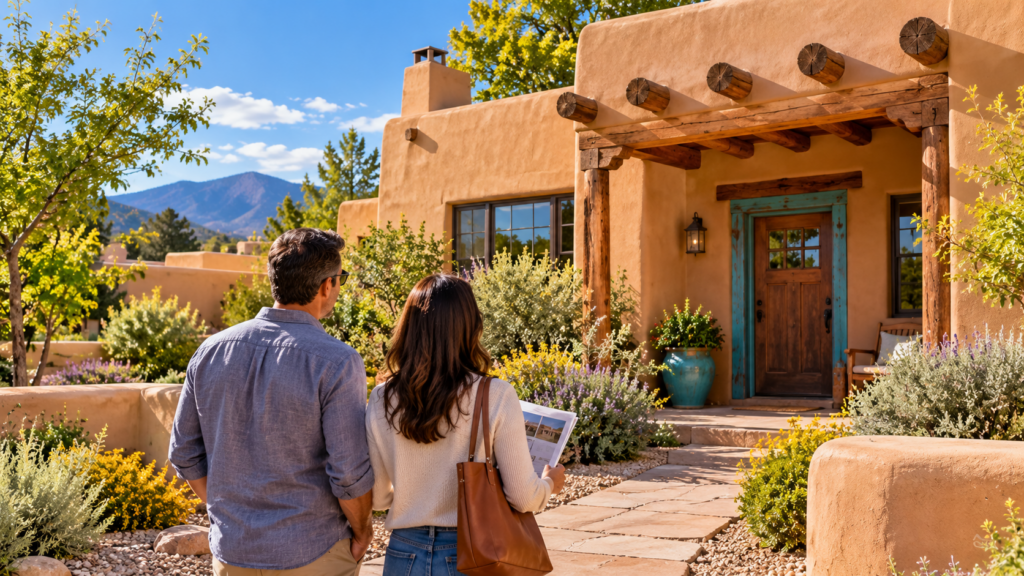
What are the first steps to buying a house in Santa Fe? Start by reviewing your credit and finances, speaking with a lender about pre-approval, and choosing a local Realtor who can help you understand your options. Before touring homes together, you’ll generally review and sign a written buyer agreement.
Taking these steps early can help you begin your home search with a clearer understanding of your budget, representation, and priorities.
Why Preparation Matters in Today’s Santa Fe Market
Buying a home is a big financial decision, and understanding current market conditions can help you plan.
A few factors are worth considering in 2026:
- Mortgage rates are elevated. According to Freddie Mac’s Primary Mortgage Market Survey, the average 30-year fixed mortgage rate reached 7.40% on October 8, 2026, compared with 6.30% a year earlier. Your actual rate will depend on your finances, loan program, and lender.
- New construction varies. Santa Fe County authorized 495 new private housing units through building permits in 2025, compared with 244 in 2024 and 926 in 2023, according to Census Bureau data published through FRED. These figures show changes in permitting activity, although they don’t tell us exactly how many new homes are available for purchase today.
- Home prices have appreciated substantially over time. The FHFA All-Transactions House Price Index for Santa Fe County reached 268.09 in 2025, up from 266.00 in 2024. The index uses 2000 as its baseline of 100, indicating significant long-term appreciation, although individual property values vary.
These numbers are useful background, but they don’t determine what you personally can afford or whether a particular home is priced appropriately.
When you’re preparing to buy, the most important thing is understanding your financial position and having the right information before making decisions.
Here’s the sequence I recommend to buyers getting started in Santa Fe.
Step 1: Check and Strengthen Your Credit
Your credit score is one important factor lenders consider when evaluating your mortgage application and the interest rate you may qualify for.
Your income, debts, assets, down payment, and loan program also matter.
Before applying for a mortgage, review your credit reports from all three major reporting companies: Equifax, Experian, and TransUnion.
You can obtain free credit reports through AnnualCreditReport.com.
Look for errors, unfamiliar accounts, or incorrect payment information.
If you find something that needs to be disputed, start early. Credit reporting companies generally have 30 days to investigate disputes, although certain circumstances allow up to 45 days.
Then focus on a few practical steps:
- Pay down revolving balances when possible. Credit utilization can affect your credit score, and reducing outstanding balances may help improve your financial position.
- Avoid unnecessary new credit. Opening new accounts shortly before applying for a mortgage can affect your credit profile.
- Maintain healthy credit habits. Make payments on time and avoid closing established accounts solely to change your score without understanding the potential impact.
If your credit needs attention, give yourself time to address errors, reduce balances, and discuss your options with a lender.
You don’t necessarily need perfect credit to buy a home. Different mortgage programs have different requirements.
The goal is to understand where you stand before you begin making offers.
If you’re coordinating a home purchase with the sale of another property, including an inherited home, tell your lender early about the timing and source of any funds you expect to use.
Having appropriate documentation available can help prevent unnecessary delays.
Step 2: Get Pre-Approved, Not Just Pre-Qualified
One of the most useful steps you can take before seriously shopping for a home is speaking with a mortgage lender.
You may hear the terms pre-qualification and pre-approval used differently.
A pre-qualification is often an initial estimate based on information you provide.
Pre-approval typically involves a more detailed review of your financial situation, although the process varies by lender.
A pre-approval letter indicates that a lender is tentatively willing to finance a purchase up to a certain amount, subject to conditions.
It isn’t a guarantee of final loan approval.
However, it can help you establish a realistic price range and demonstrate to a seller that you’ve taken steps toward securing financing.
Compare Your Lending Options
I encourage buyers to speak with more than one lender.
Compare estimated interest rates, fees, available loan programs, down payment requirements, and anticipated cash needed at closing.
Once you have a particular property in mind and provide the required application information, request official Loan Estimates from the lenders you’re considering.
These standardized documents make it easier to compare loan terms and costs.
You don’t need to have a signed purchase contract to request a Loan Estimate, but you do need to provide information about the property, including its address.
Mortgage inquiries made within a short shopping period are generally grouped together for credit-scoring purposes. The applicable window varies by scoring model, commonly ranging from 14 to 45 days.
Ask each lender about rate-lock options, including when you can lock your rate, how long the lock lasts, and whether any conditions or fees apply.
The Consumer Financial Protection Bureau provides helpful information about getting pre-approved and comparing Loan Estimates.
The more clearly you understand your financing options, the easier it becomes to evaluate homes within a comfortable budget.
Step 3: Sign a Buyer Broker Agreement
If you haven’t purchased a home in the last few years, this step may look different from what you remember.
Under industry practice changes effective August 17, 2024, real estate professionals participating in an MLS who are working with buyers generally need a written buyer agreement before touring a home with them.
This includes in-person and live virtual tours.
You can still visit an open house independently without signing a buyer agreement with the hosting agent.
When you decide to work with a buyer’s agent, the agreement helps establish expectations before you begin touring properties together.
What Does the Agreement Cover?
Your written buyer agreement should explain:
- The services your agent will provide.
- How your agent will be compensated, including a specific amount or objectively determinable rate.
- How long the agreement lasts.
- The responsibilities and obligations of both parties.
Real estate commissions are fully negotiable and are not set by law.
The agreement’s terms, including compensation and duration, should be discussed before you sign.
Depending on the transaction, the seller or listing broker may contribute toward buyer-agent compensation.
However, that contribution is not automatic, and any buyer responsibility depends on the written agreement and negotiated purchase terms.
I believe buyers should feel comfortable asking questions about every document they sign.
I take time to review the agreement with my clients and explain their options so they understand what they’re agreeing to.
Once your financing and representation are in place, you’re in a stronger position to begin a focused home search.
You can also review the National Association of REALTORS® guide to negotiating written buyer agreements.
Step 4: Start Your Search With a Local Expert
Now comes the exciting part: exploring homes that fit your needs and budget.
Once you’ve established your financial position, selected an agent, and reviewed your buyer agreement, you’re better prepared to tour properties and make informed decisions.
One challenge I sometimes see is buyers becoming attached to a property before they’ve fully considered financing, ownership costs, or the home’s practical details.
A little preparation helps avoid unnecessary surprises.
Santa Fe Has Its Own Property Considerations
Buying in Santa Fe can involve details you may not encounter in every market.
Depending on the property, these may include:
- Adobe construction: Traditional materials and maintenance considerations that may differ from those of conventional construction.
- Historic-district requirements: Rules affecting certain exterior changes, renovations, or additions.
- Acequia and water rights: Questions about rights, availability, ownership, and permitted uses that require property-specific verification.
- Title and access matters: Recorded easements, historic land-grant considerations, or other issues affecting particular properties.
These questions don’t apply to every home, but they’re worth understanding when they do.
Whether you’re exploring a historic adobe near Canyon Road, a home around Arroyo Chamiso, or a contemporary property in Las Campanas, the right questions will depend on the location and the individual property.
That’s where firsthand local knowledge and careful due diligence become especially valuable.
My role is to help you understand what you’re considering, identify questions worth investigating, and connect you with the appropriate professionals when specialized inspections or advice are needed.
The goal isn’t simply to find a home you love.
It’s to find a home that makes sense for your needs, budget, and long-term plans.
Frequently Asked Questions
How much does a buyer’s agent cost in Santa Fe?
Buyer-agent compensation is negotiable and should be clearly stated in your written agreement.
Depending on the transaction, the seller or listing broker may contribute toward that compensation.
However, any remaining buyer responsibility depends on your agreement and the negotiated purchase terms.
Review these details carefully with your agent before signing.
How long does buying a home take?
Once you’re under contract, closing often takes approximately 30 to 60 days, although the timeline varies with financing, inspections, title work, and other transaction requirements.
Preparing your credit, obtaining pre-approval, and finding the right home may add weeks or months.
Starting early gives you more time to address questions before you’re working toward a closing deadline.
What should I budget for beyond the purchase price?
Consider your down payment, closing costs, inspection and appraisal expenses, property taxes, homeowners insurance, and any applicable HOA fees.
Depending on your mortgage, you may also need mortgage insurance.
Don’t forget ongoing maintenance, utilities, and any repairs or improvements you plan to make.
If you’re considering a condominium, my guide to buying a condo in Santa Fe explains additional HOA costs and ownership considerations.
Your lender can help estimate financing-related expenses, while your agent can help you identify property-specific costs worth investigating.
Can I buy a home while selling an inherited property?
Yes, although the timing may require additional coordination.
Estate administration, property-sale timing, financing, and the availability of sale proceeds can all affect your purchase plans.
If you’re depending on funds from an inherited-property sale, let your lender and real estate professionals know early.
Understanding the timeline can help you evaluate options and avoid unnecessary gaps or overlapping expenses.
Is new construction an option in Santa Fe?
Yes. New construction is available in parts of the Santa Fe area, although options vary by neighborhood, price range, and development.
County building-permit figures provide useful background, but they don’t show which newly built homes are currently available for purchase.
If you’re interested in a newly built home, it’s worth reviewing current inventory and discussing builder contracts, construction timelines, and financing considerations.
Why Clients Choose Lori Montoya as Their Trusted Santa Fe Realtor
Buying a home in Santa Fe is a big decision, and firsthand local knowledge can make a meaningful difference.
I was born and raised here, and I’ve spent more than seven years helping buyers and sellers navigate the Santa Fe real estate market.
Here’s what I bring to the process:
- Local expertise: As a Certified Santa Fe Specialist (SFeS) and Accredited Buyer’s Representative (ABR), I combine local knowledge with specialized buyer-representation training.
- Experience: I help clients navigate the home-buying process with clear information, thoughtful preparation, and attention to the details.
- Clear guidance: I explain documents, discuss available options, and help you understand the decisions ahead.
- Coordinated planning: When a purchase depends on the sale of another property, I help clients think through the timing and practical considerations.
- Honest advice: My goal is to help you make decisions that serve your interests, even when that means reconsidering a particular property.
Whether you’re relocating, buying your first home, or preparing for your next chapter in Santa Fe, I’d be happy to help you get started.
Lori Montoya
Associate Broker | Barker Realty
530 S. Guadalupe Street
Santa Fe, NM 87501
Call or text: (505) 577-8750
SantaFeWithLori.com
Honest. Local. Personal. The way real estate should be!